 English
 عربى
عربى
You sent the same duty point — say 6,000 m³/h at 2,800 Pa — to three Chinese suppliers. One quotes a 4-72, one quotes a 9-19, one quotes a 9-26. The prices differ by more than double. Nobody explains why.
They are not quoting the same machine, and they are not all right. These three model numbers are the backbone of the Chinese centrifugal fan industry: they are standardised, they are stocked everywhere, and they cover almost every ordinary industrial duty. But each one lives in a different corner of the pressure–airflow map, and picking the wrong corner is the single most common reason a fan arrives on site and underperforms.
This guide decodes the numbers, puts the three ranges side by side, and walks through four real duties so you can check any quotation you receive in about two minutes.
Got a quotation you want checked? Send us the model, impeller diameter, speed and motor kW another supplier offered, plus your airflow, pressure and gas temperature. We will tell you whether it actually lands on the curve — free of charge. WhatsApp +86-155-5848-8379 · Email mia@zifengfan.com
TL;DR — 4-72 is the general-purpose series: high airflow at low to medium pressure (roughly 600–3,700 Pa), backward-curved blades, the highest efficiency and the lowest noise. 9-19 is the pressure specialist: up to about 16,000 Pa but at low airflow, forward-curved, 12 blades. 9-26 sits between them on pressure but delivers far more airflow than 9-19 — forward-curved, 16 blades. Choose by pressure first, then airflow. Above 80 °C or 150 mg/m³ of dust, none of the three standard builds is correct.
What the numbers actually mean
Chinese fan model numbers are not marketing codes. They encode aerodynamics:
- First digit = pressure coefficient × 10. 4-72 has a pressure coefficient of 0.4; 9-19 and 9-26 both have 0.9. Higher coefficient = more pressure per revolution.
- Second number = specific speed (ns). 4-72 → 72; 9-19 → 19; 9-26 → 26. Lower specific speed means the machine is shaped for pressure rather than flow.
- The "No." is the impeller diameter in decimetres. No.5 = 500 mm impeller, No.10 = 1,000 mm.
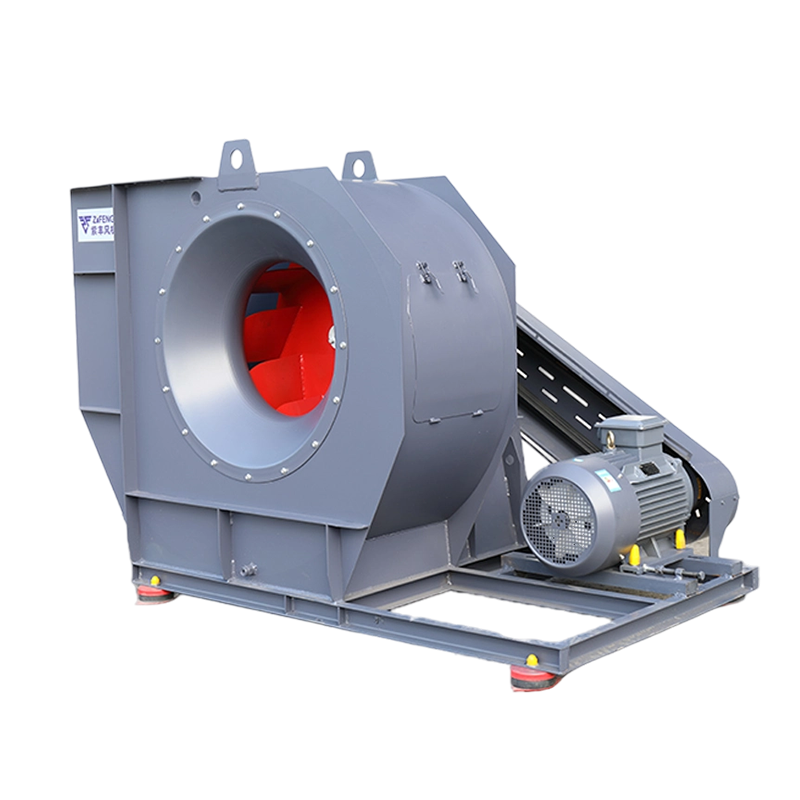
- The letter is the drive arrangement. A = direct-coupled motor; C and D = belt drive with the motor mounted off the fan housing (D is the heavy-duty version used on larger sizes).
Read a full designation like this:
4-72 No.6 D — 4-72 series, 600 mm impeller, belt drive
9-26 No.5 A — 9-26 series, 500 mm impeller, direct drive
4-72 No.6 D — 4-72 series, 600 mm impeller, belt drive
9-26 No.5 A — 9-26 series, 500 mm impeller, direct drive
This is why 9-19 and 9-26 look similar on paper but behave differently: same pressure coefficient, different specific speed. 9-19 pushes pressure to the limit and gives up airflow; 9-26 trades a little pressure for a lot more flow.
The three series side by side
| 4-72 | 9-19 | 9-26 | |
|---|---|---|---|
| Pressure range | 600 – 3,713 Pa | up to ~16,250 Pa | up to ~12,000 Pa |
| Airflow range | 700 – 295,000 m³/h | ~820 – 30,000 m³/h | ~2,000 – 123,000 m³/h |
| Impeller | Backward-curved aerofoil, 10–12 long blades | Forward-curved, 12 blades | Forward-curved, 16 blades |
| Peak efficiency | ~85–90% | ~60–72% | ~65–75% |
| Relative noise | Lowest | Highest | High — plan for a silencer |
| Gas temperature | ≤ 80 °C standard | ≤ 50 °C (80 °C max) | ≤ 50 °C (80 °C max) |
| Dust limit | General duty; heavy dust needs a radial-blade build | ≤ 150 mg/m³ | ≤ 150 mg/m³ |
| Typical duty | Factory ventilation, HVAC, dust collection, drying | Forging furnaces, dense pneumatic conveying, high-resistance systems | Pneumatic conveying, kilns, long duct runs, boiler forced draft |
| Relative price | Baseline | Highest of the three | ~1.3–2× a comparable 4-72 |
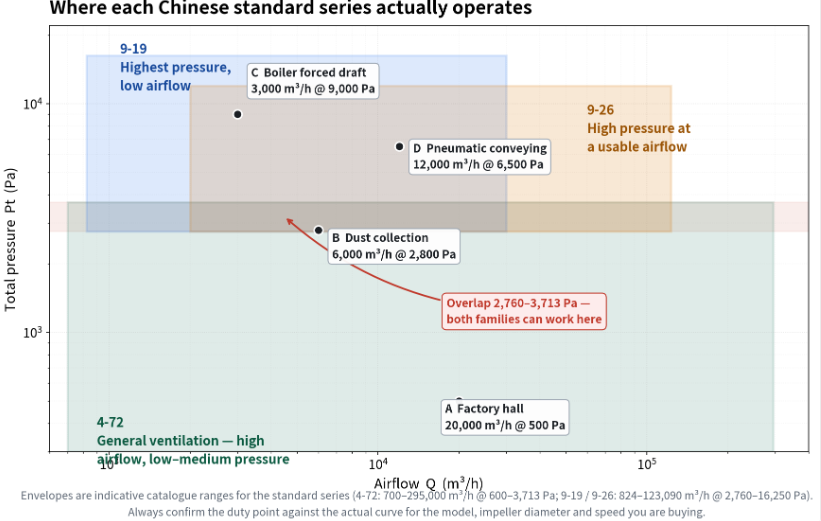
Ranges are indicative catalogue envelopes for the standard series. Always confirm against the actual curve for the exact model, impeller diameter and speed being quoted.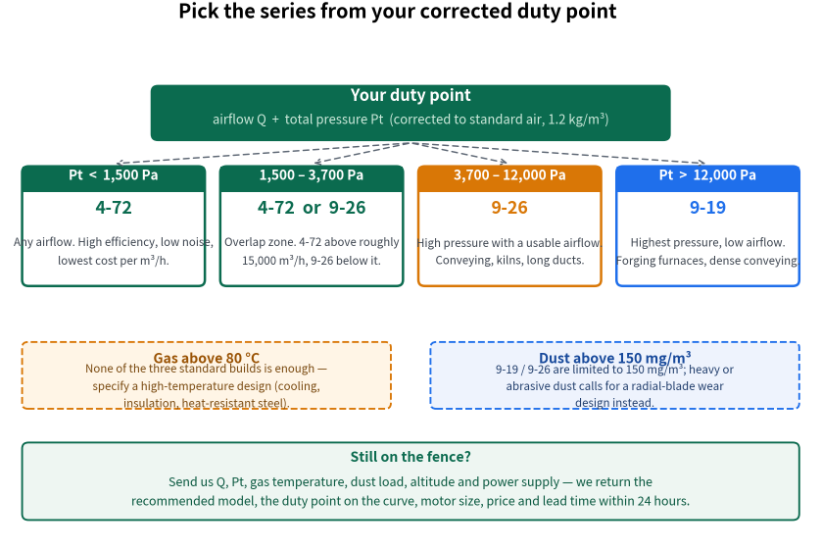
Log-log duty map showing the catalogue envelopes of Chinese standard fan series 4-72 (700 to 295,000 cubic metres per hour at 600 to 3,713 Pa), 9-19 (up to 16,250 Pa at low airflow) and 9-26 (up to 12,000 Pa with higher airflow), with four marked duty points: factory hall 20,000 m3/h at 500 Pa, dust collection 6,000 m3/h at 2,800 Pa, boiler forced draft 3,000 m3/h at 9,000 Pa, pneumatic conveying 12,000 m3/h at 6,500 Pa.
Figure 2 · Where each series actually operates. Note the red overlap band between 2,760 and 3,713 Pa — that is the region where two different suppliers can honestly quote two different series.
Why blade shape drives everything
A backward-curved aerofoil blade accelerates air smoothly and turns it efficiently — that is why 4-72 is quiet and cheap to run, and why its power curve is non-overloading (power peaks then falls, so a bigger motor is never at risk). Forward-curved blades pack far more energy into each revolution, which is where the pressure comes from — but they are less efficient, louder, and their power curve keeps rising with airflow. Run a 9-19 against an unexpectedly low resistance and it will overload the motor. That is a real failure mode, not a theoretical one.
4-72 — the general-purpose workhorse
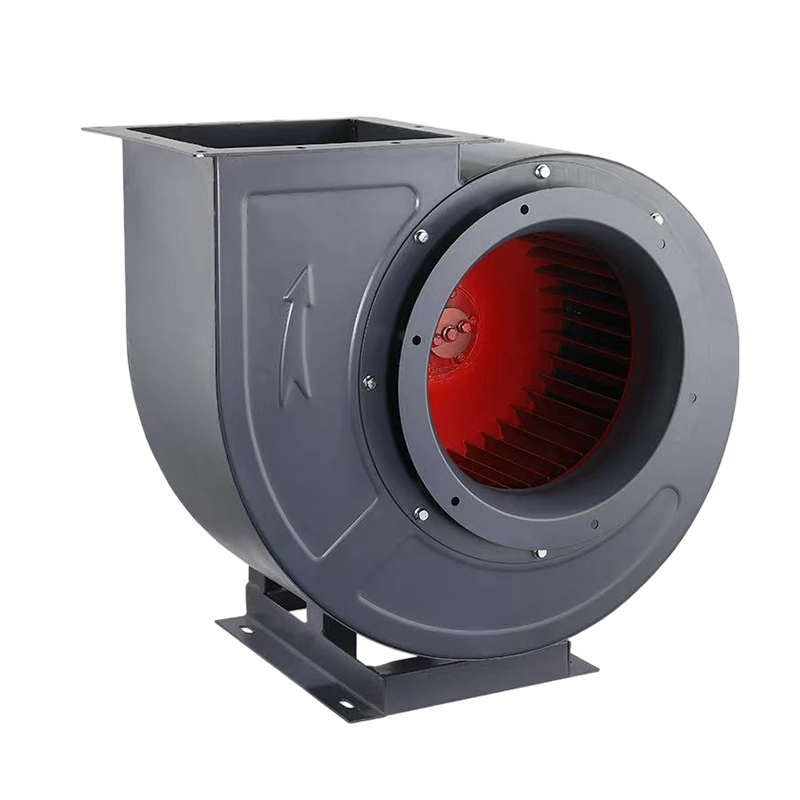
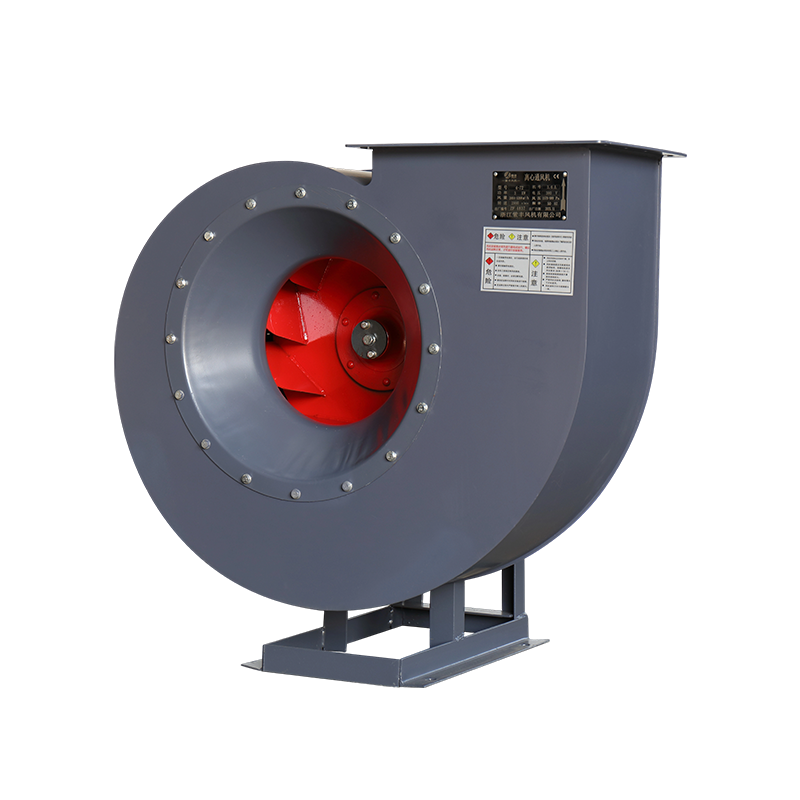
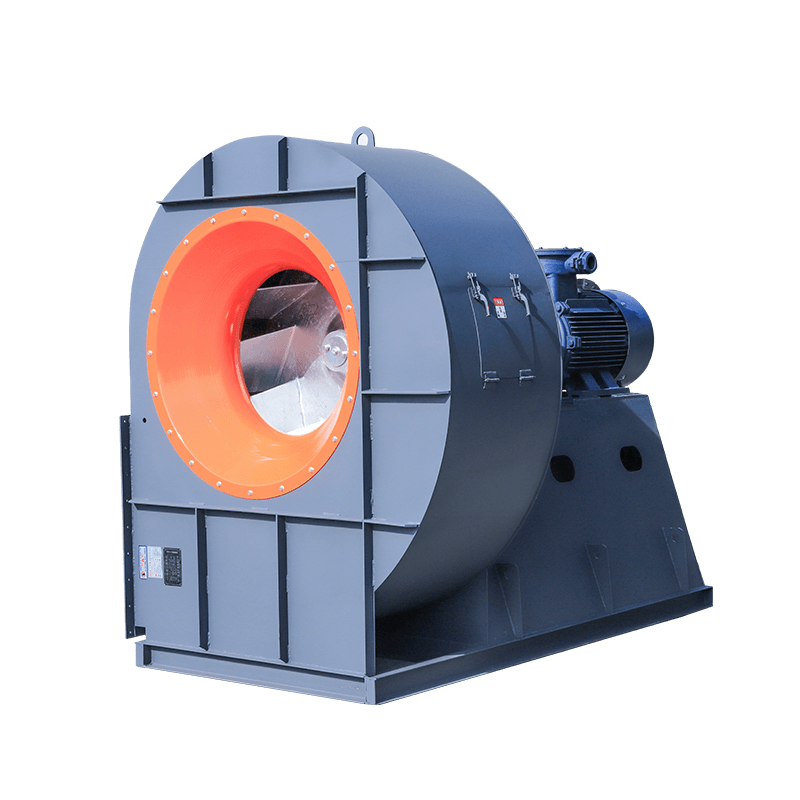
If your system resistance is under about 1,500 Pa, 4-72 is almost always the answer, whatever the airflow. It is the most widely stocked fan in China, spare parts are available anywhere, and any competent technician has seen one before.
Use it for: factory and warehouse ventilation, HVAC supply and return, dust collection with modest resistance, drying lines, greenhouse and agricultural ventilation, clean process air.
Do not use it when: resistance exceeds roughly 3,700 Pa (you would be pushing the fan to the unstable right-hand end of its curve); the gas is hot, abrasive or corrosive in a way the standard carbon-steel build cannot take; or you need high pressure in a compact footprint.
9-19 — when you need pressure, not volume
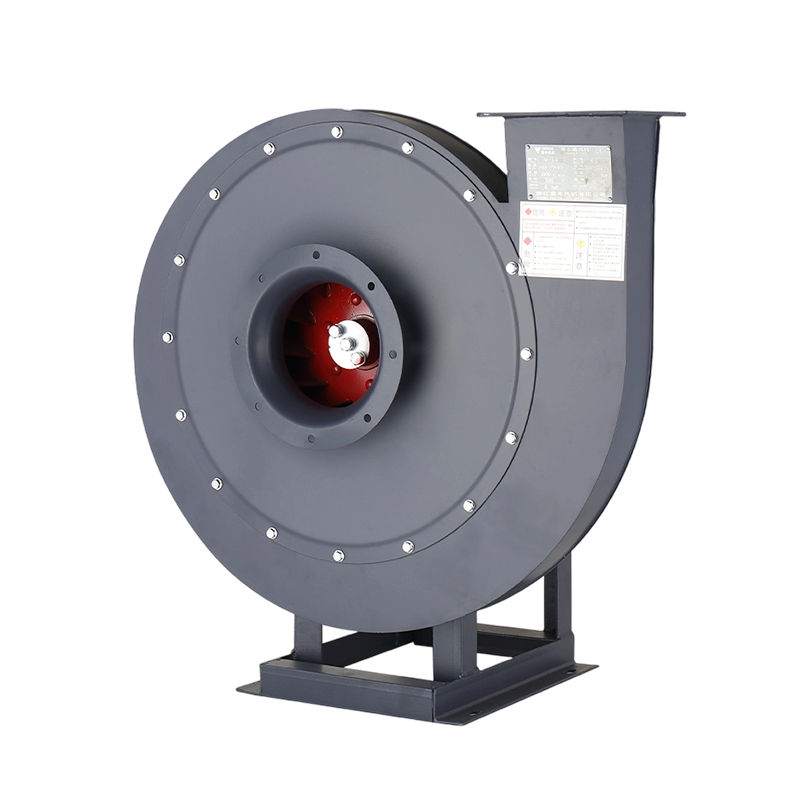
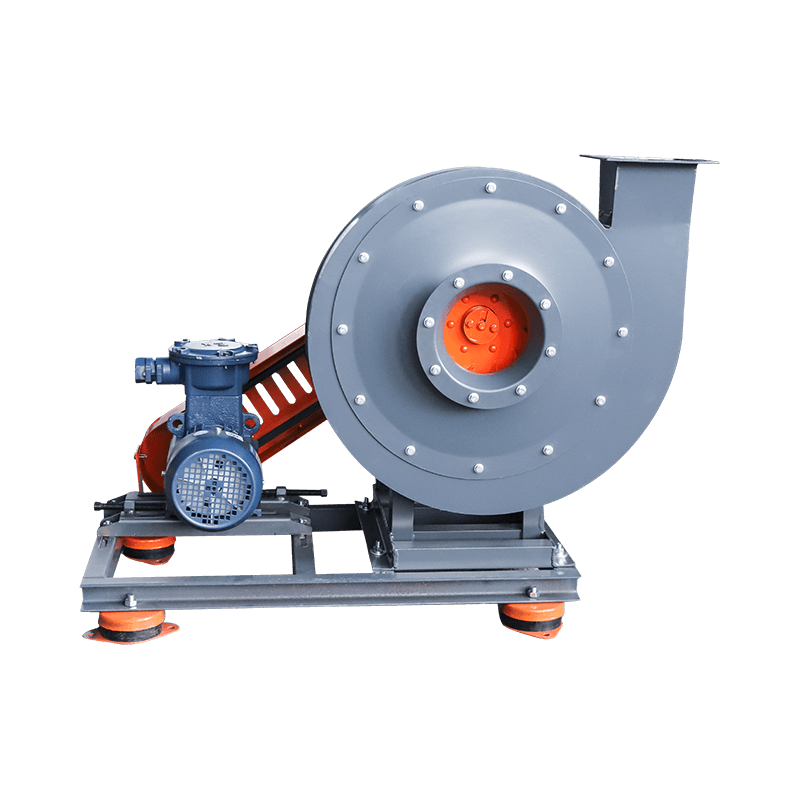
9-19 is the series you reach for when the system resistance is genuinely high and the airflow is modest: forging and melting furnaces, dense-phase conveying, high-resistance packed beds, small boilers with restrictive ductwork.
Two warnings. First, the forward-curved power curve rises with airflow — always start against a closed damper and size the motor with headroom, or you will trip on startup. Second, noise: at 10,000 Pa and above, 9-19 is loud. Budget for an inlet or outlet silencer and check what your local regulations allow.
9-26 — high pressure with usable airflow
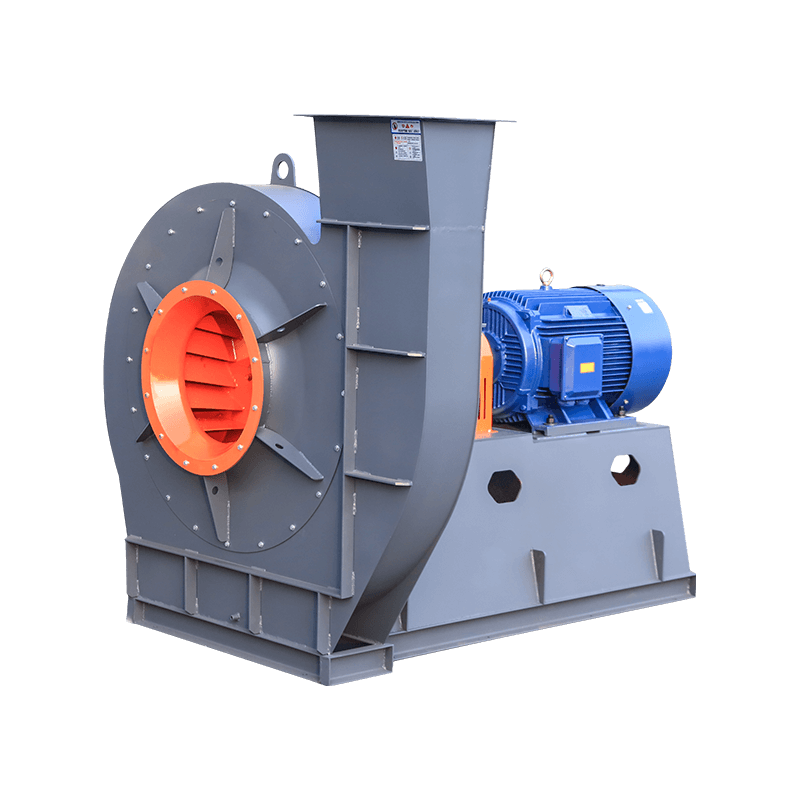
9-26 is the most misunderstood of the three. Buyers assume "higher number = more pressure", so they ask for 9-26 thinking it is an upgrade on 9-19. It is not — it is a different point on the map: lower peak pressure, but a far more usable airflow. Its 16 blades give smoother gas flow and a broader stable range than 9-19.
Typical duties: pneumatic conveying of powder and granules, cement and lime kilns, long duct runs with many elbows, boiler forced draft where volume matters, fluidised beds.
Four real duties, four answers
Each example uses the standard motor sizing formula, P = Q × Pt / (1000 × η) with a 1.15 service factor.
| # | Duty | Q | Pt | Why that series | Motor |
|---|---|---|---|---|---|
| A | Factory hall ventilation | 20,000 m³/h | 500 Pa | Low pressure, high volume — squarely in 4-72 territory. A 9-19 here would be a costly mistake. | ~4 kW |
| B | Dust collection | 6,000 m³/h | 2,800 Pa | Overlap zone. 4-72 No.6 gives better efficiency and lower noise; 9-26 No.5 is more compact and copes better as the filter loads up. Decide on filter behaviour. | ~7.5 kW |
| C | Boiler forced draft | 3,000 m³/h | 9,000 Pa | High pressure at low flow — 9-19 No.5 is the standard answer. Check the temperature: above 80 °C you need a high-temperature build, not a standard 9-19. | ~15 kW |
| D | Pneumatic conveying | 12,000 m³/h | 6,500 Pa | High pressurewithreal airflow — 9-26 No.6.3. A 9-19 of the same size would not move this volume. | ~37 kW |
Motor figures are indicative, calculated at the efficiencies typical of each series (4-72 ≈ 0.80, 9-19 ≈ 0.70, 9-26 ≈ 0.72) with a 1.15 service factor. Final ratings come from the actual curve and test data.
Where the ranges overlap — and how to choose
Between roughly 2,760 and 3,713 Pa both 4-72 and 9-19/9-26 can technically do the job, which is exactly why three suppliers quote three different models. Break the tie on these five questions:
- Will resistance grow over time? Filters load up, ducts scale. If the duty will drift upward, 9-26 gives you headroom; 4-72 does not.
- Is power cost or noise a constraint? 4-72 wins both, usually by a wide margin.
- Is space tight? For the same duty, the high-pressure series is usually the smaller machine.
- How stable is the airflow? Forward-curved fans overload if resistance drops; backward-curved do not.
- What about spares? 4-72 parts are available from almost any supplier in any Chinese city; the same is less true for 9-19/9-26.
Five specification traps we see in incoming RFQs
- Using 9-19 for ordinary ventilation. It works, but you pay for pressure you never use, in both money and electricity.
- Pushing 4-72 past 3,700 Pa. The fan ends up on the flat, unstable part of its curve where small resistance changes cause large airflow swings.
- Comparing model numbers without speed. A No.6 at 2,900 rpm and the same No.6 at 1,450 rpm differ by roughly a factor of four on pressure. The model number alone tells you nothing.
- Ignoring the temperature and dust limits. Standard 9-19/9-26 are rated to about 50 °C and 150 mg/m³. Beyond that you need a different machine, not a bigger one.
- Assuming the same model number means the same performance across suppliers. It does not. Two factories' 4-72 No.6 can differ on blade profile, housing tolerances and balance grade. Always ask for the curve.
Not sure which one your RFQ should name? Download our one-page Fan Sizing Data Sheet, fill in airflow, pressure, temperature, dust, altitude and power supply, and send it back. You get the recommended series, the exact model and speed, the duty point on the curve, motor and material options, FOB Ningbo price and lead time — usually within 24 hours. WhatsApp +86-155-5848-8379 · Email mia@zifengfan.com
FAQ
What does "4-72" actually mean?
The first digit is the pressure coefficient times ten (0.4) and the second is the specific speed (72). The machine is shaped for high airflow at low to medium pressure. The "No." that follows is the impeller diameter in decimetres, and the trailing letter is the drive arrangement: A for direct drive, C or D for belt drive.
Is 9-26 more powerful than 9-19?
Not in the way the numbering suggests. Both have a pressure coefficient of 0.9, but 9-26 has a higher specific speed (26 vs 19): it gives up some peak pressure and returns far more airflow. Think of 9-19 as the pressure extreme and 9-26 as the balanced high-pressure machine.
Can a 4-72 handle 3,000 Pa?
Yes, but you are near the top of its range. It will work, though efficiency drops and noise rises. If your resistance estimate is uncertain, or if it will grow as filters load, 9-26 is usually the safer call.
Which series should I use for a boiler induced draft fan?
Neither of the three standard builds, if the gas is hot. Standard 4-72 is limited to about 80 °C and 9-19/9-26 to roughly 50 °C. Boiler ID duty typically needs a dedicated high-temperature fan with a cooling arrangement, heat-resistant steel and an insulated housing. Tell us the gas temperature and we will specify it properly.
Can I use 9-19 or 9-26 for dust extraction?
Only up to about 150 mg/m³ of dust. Above that — sawdust, cement dust, mineral fines — specify a radial-blade impeller with wear protection instead. Blade choice is a duty decision, not a preference.
Do these models work on 60 Hz or 415 V?
Yes. Motors can be wound for 220/380/415/440 V and 50 or 60 Hz. Note that on 60 Hz the fan runs faster and delivers more pressure and airflow, so the duty point must be recalculated — do not simply reuse a 50 Hz selection.
Is there an equivalent European or American model number?
No direct equivalent — Chinese model numbers are a national standard series, not a brand. What translates is theaerodynamic type: 4-72 behaves like a standard backward-curved industrial fan, 9-19 and 9-26 like forward-curved high-pressure blowers. If you are replacing a Western unit, send us the duty point rather than the old model number.
What is your lead time and minimum order?
Standard models usually ship in 7–15 days; custom-built or high-temperature units take 15–30 days depending on material and motor. We accept small trial orders and support OEM/ODM with private labelling.
Zhejiang Zifeng Fan Co., Ltd. — manufacturing industrial fans and motors since 1997 · 12,000 m² plant · 100+ standard models · 120 km from Ningbo Port.
Tell us your airflow, pressure and temperature — get a selection and a quote within 24 hours.
WhatsApp +86-155-5848-8379 · Email mia@zifengfan.com
Tell us your airflow, pressure and temperature — get a selection and a quote within 24 hours.
WhatsApp +86-155-5848-8379 · Email mia@zifengfan.com